




Single-Deck Blackjack Mathematics: Natural Frequency vs the 6:5 Penalty

Single-deck blackjack gives the player slightly more natural blackjacks than a multi-deck game. It also makes each exposed card more important. Neither fact makes a single-deck table automatically attractive. A reduced natural payout can cost far more than the small frequency gain is worth.
We can quantify that tradeoff without estimating a complete blackjack strategy. The calculations below begin with freshly shuffled standard decks, no jokers or bonus rules, and ordinary two-card naturals. Opposing player and dealer naturals push.
Calculate the natural probability
With D decks, the pack contains 52D cards, including 4D aces and 16D ten-valued cards. A natural arrives in either order: ace then ten, or ten then ace. After the first card, the denominator falls by one.
P(player natural) = 2 × (4D / 52D) × (16D / (52D − 1))
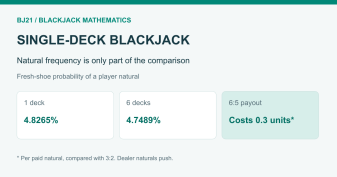
For one deck this is 2 × (4/52) × (16/51) = 0.04826546, or 4.826546%. For six decks it is 2 × (24/312) × (96/311) = 4.748949%. The single-deck advantage in natural frequency is about 0.07760 percentage points.
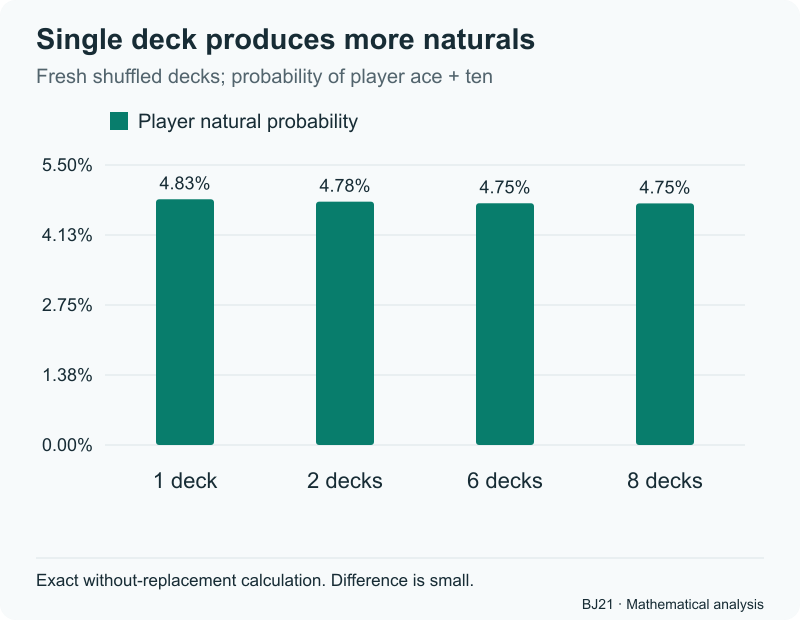
| Decks | Natural probability | Expected naturals per 1,000 fresh rounds |
|---|---|---|
| 1 | 4.826546% | 48.265 |
| 2 | 4.779686% | 47.797 |
| 6 | 4.748949% | 47.489 |
| 8 | 4.745134% | 47.451 |
Across 1,000 independent fresh-deck rounds, the single-deck expectation is less than one extra natural compared with six decks. That is an expected count, not a schedule. Real shoes also contain depleted-deck states, so this table describes the fresh-pack probability rather than every round played before a cut card.
A payout change affects almost every winning natural
A 3:2 natural pays profit 1.5B on an initial wager B. A 6:5 natural pays 1.2B. The reduction is 0.3B whenever the player’s natural receives the natural payout. On a $25 wager, that is $7.50 less profit.
We must exclude rounds in which the dealer also has a natural. Those rounds push under both payout rules, so changing 3:2 to 6:5 does not cost 0.3B there.
Conditional on the player receiving ace-ten, the remaining pack contains 52D − 2 cards, 4D − 1 aces and 16D − 1 tens. Therefore:
q = P(dealer natural | player natural) = 2 × [(4D − 1)/(52D − 2)] × [(16D − 1)/(52D − 3)]
Added expected loss from 6:5 = 0.3B × P(player natural) × (1 − q)
This conditions on the actual removed cards. Multiplying two independent natural probabilities would ignore the relationship between the player’s and dealer’s cards, with the largest error in a single deck.
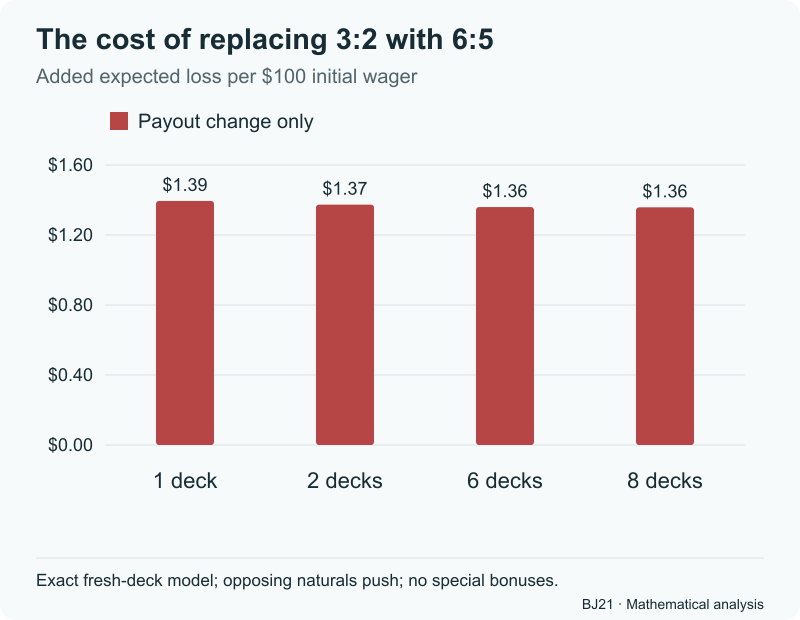
| Decks | Dealer natural given player natural | Added loss per $100 initial bet |
|---|---|---|
| 1 | 3.673469% | $1.394773 |
| 2 | 4.212774% | $1.373499 |
| 6 | 4.562063% | $1.359690 |
| 8 | 4.605163% | $1.357984 |
In the single-deck model, the payout cut alone adds about 1.3948 percentage points to expected loss per initial wager. Over 100 independent fresh-pack rounds at $25 initially per round, that difference is about $34.87 in expectation. Other rule differences would change the comparison.
Why fewer decks help in more ways than naturals
The full effect of deck count includes more than the first two cards. Removing cards changes future hit probabilities, dealer outcomes, doubles and splits. The optimal action can depend on the composition of a total as well as its numerical value. A natural-frequency calculation therefore cannot substitute for a complete house-edge calculation.
As a separate reference, Shackleford’s rule-variation table gives a 0.48 percentage-point improvement in player return for single deck relative to its eight-deck baseline. That baseline is S17 with doubling on any two initial cards, doubling after splitting and up to four split hands. Its overall deck-count effect is different from the isolated natural-frequency difference above.
The reference helps explain the scale: an otherwise favorable reduction in deck count is much smaller than the payout cut in our single-deck model. Do not turn those figures into an advertised edge for an actual table by adding them mechanically; the exact rules and dealing procedure still need to match.
The information effect of one exposed card
A single known card represents 1/52 of a fresh single deck, but only 1/312 of six decks. After substantial depletion, the effect becomes larger again. This is why exact card composition and remaining-card estimates matter more in short packs.
It does not follow that every single-deck game is a better counting opportunity. Shuffle timing limits how long favorable composition can persist and how often it can be used. A short pack shuffled early may offer fewer useful opportunities than its label suggests. That question requires a rules-and-penetration analysis, not just the number of decks.
When comparing tables, begin with the natural payout, then record soft-17 behavior, doubling and split rules, surrender, and shuffle conditions. “Single deck” is one input. It is not the conclusion.
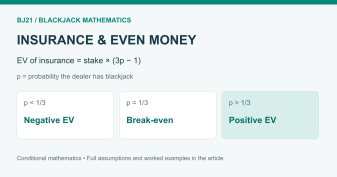
The same card-removal reasoning appears in our insurance and even-money calculations, where known cards change the conditional probability of dealer blackjack.
Sources and calculation notes
- Michael Shackleford, blackjack rule variations: reference full-game effect of deck count and stated baseline.
The natural probabilities and 6:5 penalties are original exact combinatorial calculations. They assume identical settlement except for the natural payout, opposing naturals pushing, and a fresh shuffled pack for each evaluated round.


Please log in or register to leave a comment