



Free Bet Blackjack Mathematics: Cash Hands, Free Tokens and Dealer 22
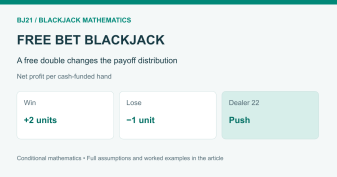
A Free Bet Blackjack token changes the payoff function. It is not a cash chip that the player owns, and it is not simply a second ordinary wager. That distinction explains why the strategy for a token-funded hand can differ from the strategy for the cash-funded hand beside it.
This analysis uses the six-deck, H17, 3:2 version described by Michael Shackleford: free doubles on two-card hard 9–11, free splits except tens, doubles after splitting, resplitting to four hands including aces, and no surrender. Ordinary paid doubles remain available on other two-card hands. Dealer 22 pushes surviving ordinary hands. Other versions need their own rules check.
Account for net profit, not chips returned
Let B be the original cash wager. A winning ordinary hand pays profit B and returns the stake B. The total returned is 2B, but the net profit is only B. Mixing those two accounting systems makes free bets look more generous than they are.
After a free double on a cash-funded hand, a win produces profit 2B. A loss costs the original B. A push returns the original stake for zero net profit. The free token itself is never money you can take from a losing or pushing hand.
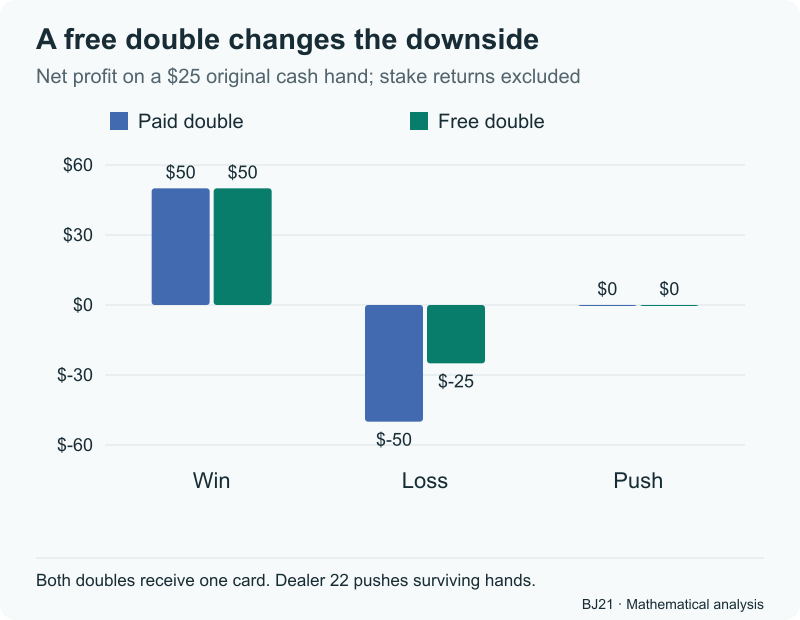
| Result | Ordinary paid double | Free double on cash hand |
|---|---|---|
| Win | +2B | +2B |
| Loss | −2B | −B |
| Push | 0 | 0 |
If the resulting win, loss and push probabilities are w, l and p, the free-double EV is 2w − l units. A paid double on the same resulting hand distribution has EV 2w − 2l. The free wager improves that comparison by l units.
That calculation compares two ways of funding the same double. It does not prove that doubling beats hitting: hitting permits more draws and therefore has a different outcome distribution. Every actual decision must compare the EVs of the legal actions.
A free split creates a different kind of hand
Consider an undoubled token-funded hand of face value B. If it wins, it earns B in real chips. If it loses, the player loses no cash on that hand. If it pushes, the player also receives no profit. The token is removed in either of those last two outcomes.
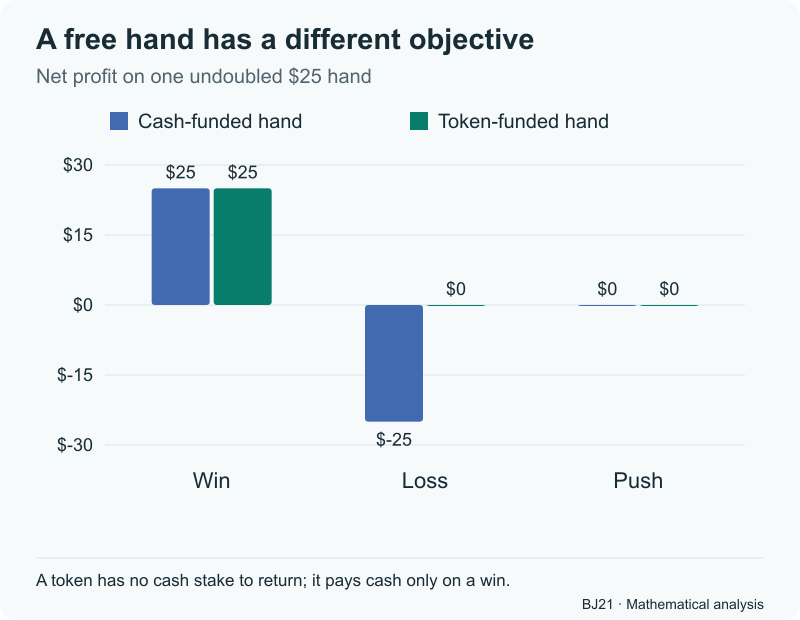
Cash-hand EV = w − l; token-hand EV = w
For a token hand, turning a loss into a push does not improve the cash result. Turning either outcome into a win does. A cash hand values a push because it avoids losing a stake. This difference can make a more aggressive action preferable on a free hand.
A worked decision with invented probabilities
The following probabilities are deliberately hypothetical, chosen to isolate the payoff mechanism. They are not recommendations for any blackjack total.
| Action | Win | Loss | Push | Cash EV | Token EV |
|---|---|---|---|---|---|
| A | 40% | 30% | 30% | +0.10B | +0.40B |
| B | 45% | 40% | 15% | +0.05B | +0.45B |
A cash-funded hand prefers A: 0.40 − 0.30 = 0.10, exceeding B’s 0.45 − 0.40 = 0.05. A token-funded hand prefers B because its 45% chance of a paid win exceeds A’s 40%. The action ranking reverses even though the outcome probabilities are unchanged.
This is why one ordinary blackjack chart cannot represent all the decisions in the variant. The state includes how the hand is funded, not just the player’s total and the dealer’s upcard.
Dealer 22 pays for the concession
In conventional blackjack, a dealer total of 22 busts and pays surviving ordinary wagers. In this variant, those hands push. A player who busted earlier does not recover the lost cash wager merely because the dealer later reaches 22.
For a fixed policy, the loss from replacing a paid win with a push can be written as:
Lost return = E[would-be winning profit × indicator of a surviving hand and dealer 22]
For an undoubled cash hand, each affected outcome loses one unit of potential profit. For a free-doubled cash hand, it loses two. A token hand also loses the cash profit it would otherwise have earned. The event must include player survival; using the dealer’s raw probability of 22 overcounts hands already dead.
The exact cost requires the joint distribution of player and dealer outcomes across the variant’s strategy. It cannot be found by subtracting a generic dealer-22 percentage from the value of free doubles. Strategy changes alter how often the player reaches each settlement.
Free opportunities do not imply a player edge
Shackleford reports a 1.04% house edge for the stated version using its appropriate strategy. Treat that as a figure for a particular rules package, not every table carrying the name. His strategy separates cash hands, free hands and pairs.
For illustration, a 1.04% edge corresponds to an expected loss of $1.04 per $100 initial wager, or $26 across 100 rounds at $25 initially per round. The tokens do not create additional player-funded initial action, and a short session’s result will vary widely around its expectation.
Before applying a chart, check the natural payout, eligible free doubles, split restrictions, dealer soft-17 rule and settlement of dealer 22. Keep optional side bets out of the base-game calculation; their stakes and pay tables require separate analysis.
Sources and calculation notes
- Michael Shackleford, Free Bet Blackjack: specified rules, settlement, strategy distinction and 1.04% reference edge.
Payoff charts, algebra and the hypothetical action comparison are original. They explain the funding mechanism; they do not replace a complete strategy calculation.


Please log in or register to leave a comment