



Blackjack Insurance and Even Money: The One-Third Threshold Explained
Insurance is a wager on the dealer’s hidden card. When the dealer shows an ace, the bet wins if that card is worth ten. The player’s total does not enter the payout formula, but the actual cards in the player’s hand can change the probability by removing cards from the unseen pool.
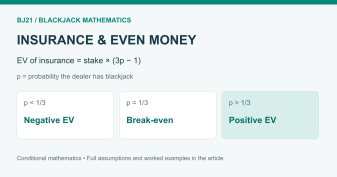
The essential calculation is small enough to do exactly. Let p be the conditional probability that the dealer has blackjack, and let I be the insurance stake. Standard insurance pays 2:1 profit when it wins and loses the stake otherwise.
Derive the threshold
EV(insurance) = 2Ip − I(1 − p) = I(3p − 1)
At p = 1/3, the expectation is zero. Above one third, insurance has positive expectation; below one third, it has negative expectation. This is a strict profitability threshold: equality is break-even, not an edge.
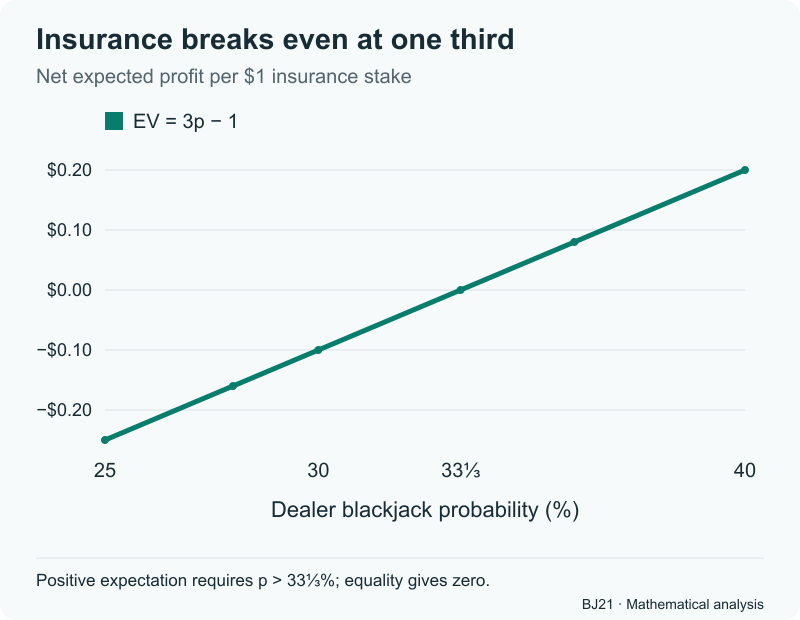
With a $50 insurance stake and p = 0.30, EV is 50 × (0.90 − 1) = −$5. With p = 0.36, it is 50 × (1.08 − 1) = +$4. These are expectations per insurance opportunity, not predictions for the next bet.
Count the unseen cards correctly
If the unseen pool contains T ten-valued cards among N cards, and the hole card is equally likely to be any of them, p = T/N. The dealer’s hidden card belongs in N; exposed cards do not. A burned card whose identity is unknown remains part of the unknown pool for this information-based calculation.
Positive insurance EV ⇔ 3T > N
In a fresh single deck, suppose the dealer shows an ace and the player holds a ten and a 6. With no other cards known, 49 cards are unseen and 15 are ten-valued. Thus p = 15/49, giving insurance EV 3 × 15/49 − 1 = −4/49, or −8.1633% of the insurance stake.
Replace the player’s hand with 5 and 6. There are still 49 unseen cards, but now 16 tens remain. Insurance EV becomes −1/49, or −2.0408%. Both bets are unfavorable, but not equally unfavorable. The second hand being a better doubling total has nothing to do with the insurance payout; card removal explains the difference.
| Known situation; dealer ace | T / N | Insurance EV per $1 |
|---|---|---|
| Single deck; player 10,6 | 15 / 49 | −$0.081633 |
| Single deck; player 5,6 | 16 / 49 | −$0.020408 |
| Six decks; player 10,6 | 95 / 309 | −$0.077670 |
| Known unseen pool | 27 / 78 | +$0.038462 |
In the final example, 27/78 exceeds one third. If the initial wager is $100 and insurance is $50, its expected profit is 50 × 0.038462 = $1.9231. Expressing the same result as 3.8462% of the insurance stake or 1.9231% of the initial wager requires different denominators. Neither is the whole game’s edge.
Why even money is equivalent at 3:2
Now give the player a natural blackjack and the dealer an ace. At a 3:2 table, declining insurance yields profit 1.5B if the dealer lacks blackjack, or zero if both have naturals and push.
EV(decline) = 1.5B(1 − p)
Taking full insurance of B/2 locks in profit B. If the dealer has blackjack, the main hand pushes and insurance wins B. If the dealer lacks blackjack, the main hand wins 1.5B and insurance loses B/2. Either way, net profit is B. That is the same cash outcome as accepting even money.
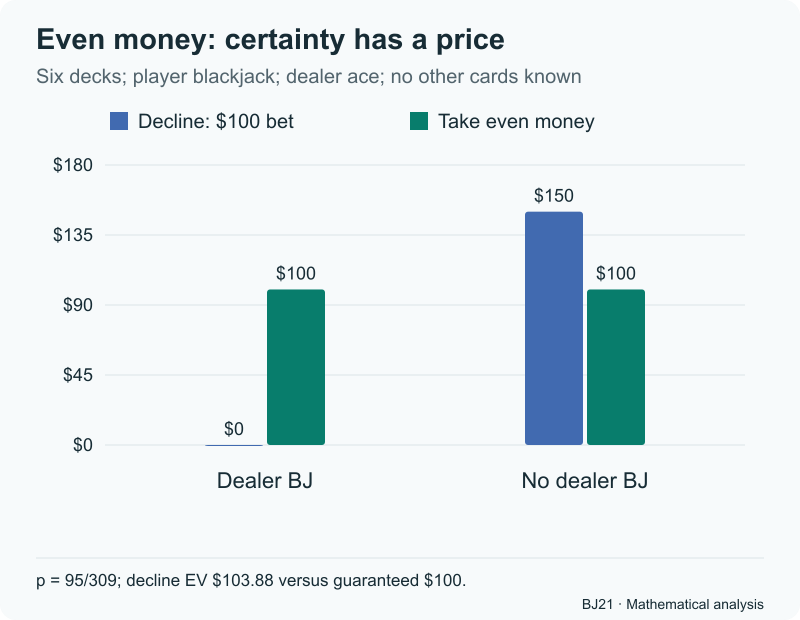
With six decks and those three visible cards, 95 tens remain among 309 unseen cards. Declining has EV 1.5 × 214/309 = 1.038835 units, versus 1 unit for even money. On a $100 natural, the expectation sacrificed for certainty is about $3.88.
Those figures are conditional on already having a natural against an ace. They are not a 3.88% loss on every initial blackjack wager. Averaging across all rounds would also require the frequency of this opportunity.
Certainty and expectation are separate quantities
Declining even money produces either 0 or 1.5B, with variance 2.25B²p(1 − p). Accepting produces B in both outcomes and therefore has zero variance for the combined hand, assuming full settlement as described. At p = 1/3, the expectations are equal, but the variance still differs.
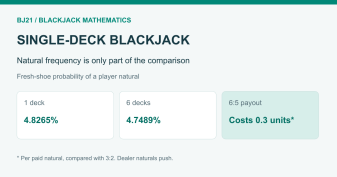
At a 6:5 table, buying B/2 of insurance does not create even money. If the dealer has blackjack, the combined profit is B. Otherwise it is 1.2B − 0.5B = 0.7B. The standard insurance threshold remains one third, but the familiar guaranteed-profit equivalence disappears. A separately offered cash-out needs its own payoff calculation.
A count-based insurance index estimates the required ten density. It does not override the exact condition T/N > 1/3 when composition is known. Keep that distinction clear when practising deviations or evaluating an unusual shoe.
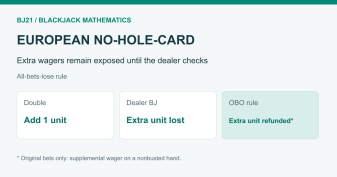
For the separate question of how dealer blackjack affects added double and split wagers, see European no-hole-card settlement and wager exposure.
Sources and calculation notes
- Michael Shackleford, insurance and even money: insurance settlement and the standard 3:2 equivalence.
- Michael Shackleford, Hi-Lo card counting: published insurance index as a count-based approximation.
- BJ21 deviations chart: related practical counting reference.
All probabilities, payoff equations, variance expressions and charts above are independently calculated under standard 2:1 insurance and the explicitly stated natural payout.


Please log in or register to leave a comment