




H17 vs S17: Why More Dealer Busts Can Still Cost You Money

When a dealer hits soft 17, another card creates a chance of busting. That sounds helpful to the player. The missing part is that it also lets the dealer replace a weak 17 with 18, 19, 20 or 21. The value of those changes depends on the player’s hand, not on bust frequency alone.
H17 means the dealer hits a 17 containing an ace still counted as 11. S17 means the dealer stands on that total. Both rules normally require standing on hard 17. We can isolate the difference by starting the dealer at soft 17 and following every possible draw.
Start with one state, not the whole game
The calculations below use an infinite-deck model: each draw has probability 1/13 for an ace or each rank 2–9, and 4/13 for a ten-valued card. Cards are effectively drawn with replacement. This removes depletion effects and makes the mechanism transparent.
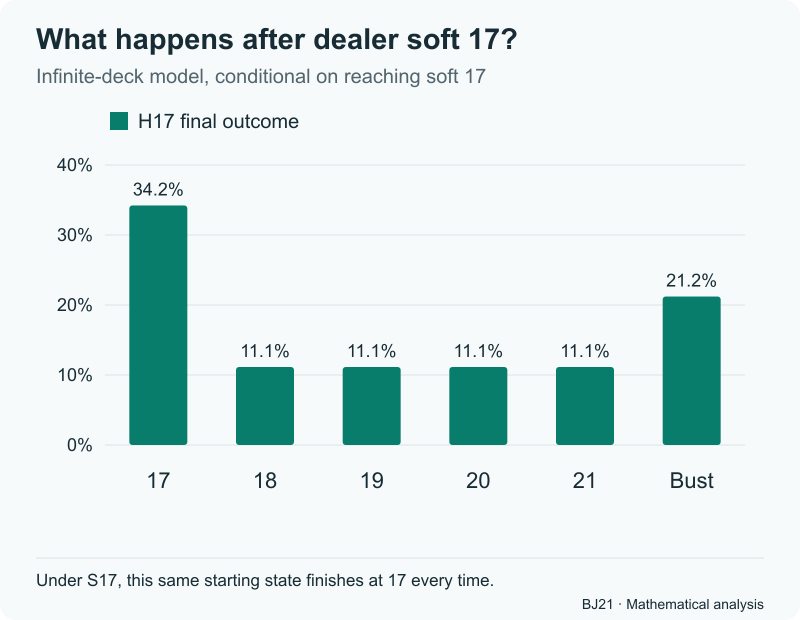
Under S17, the dealer finishes at 17 with probability 100%. Under H17, a ten converts soft 17 to hard 17; an ace produces soft 18; a 5 converts the total to hard 12 and play continues. The ace is reduced from 11 to 1 whenever necessary to avoid an immediate bust.
| Final result | S17 | H17 |
|---|---|---|
| 17 | 100.0000% | 34.2194% |
| 18 | 0% | 11.1424% |
| 19 | 0% | 11.1424% |
| 20 | 0% | 11.1424% |
| 21 | 0% | 11.1424% |
| Bust | 0% | 21.2109% |
The H17 bust probability is about 21.21%. Yet the dealer also finishes above 17 about 44.57% of the time. A player standing on 17 wins on the busts, loses to 18–21, and pushes against 17. Those losses exceed the new wins.
Compute the value to the player
For an ordinary standing total t, let B be the dealer-bust probability and P(k) the probability that the dealer finishes at k. Net EV per wager is:
EV(t) = B + P(dealer finishes below t) − P(dealer finishes above t)
The dealer totals considered here run from 17 through 21. A tie contributes zero. This equation excludes player naturals and assumes an ordinary one-unit hand.
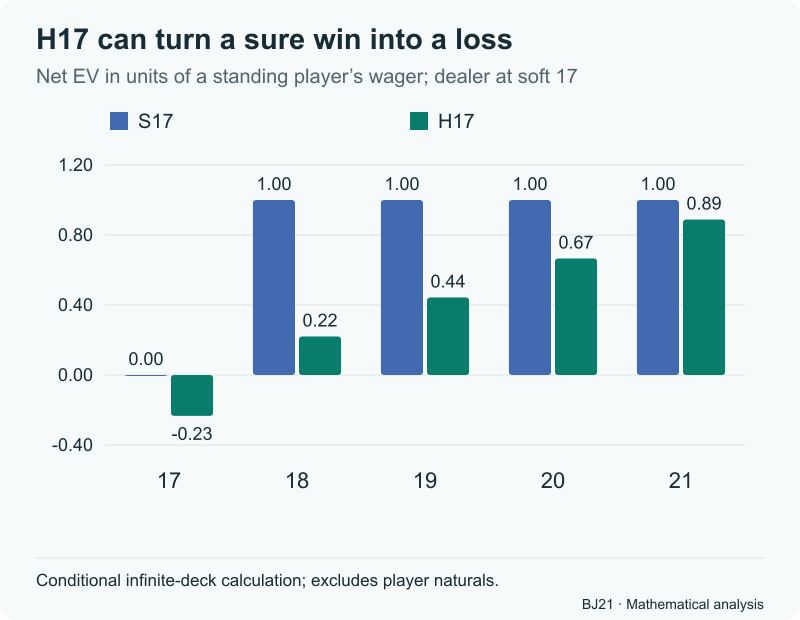
For a player 17 against the dealer’s soft 17, S17 gives a certain push: EV = 0. H17 instead gives 0.212109 − 4 × 0.111424 = −0.233588. A $100 standing wager has conditional expected profit of approximately −$23.36 in that state.
A player 18 shows the other side of the same effect. Under S17, 18 beats 17 for a certain +1 unit. Under H17, the player wins against a bust or final 17, pushes against 18, and loses to 19–21. The EV falls to +0.220030 units. The player still has an advantage in this particular state, but much less of one.
| Player total | S17 EV | H17 EV |
|---|---|---|
| 17 | 0.000000 | −0.233588 |
| 18 | +1.000000 | +0.220030 |
| 19 | +1.000000 | +0.442878 |
| 20 | +1.000000 | +0.665727 |
| 21, not a natural | +1.000000 | +0.888576 |
Why this is not the H17 house-edge penalty
These large conditional differences apply only after the dealer reaches one particular state. Many rounds never reach soft 17. Some player hands have already busted, some are naturals, and other hands involve doubles, splits or different optimal decisions.
To calculate the full-game effect, a model must weight all initial deals and subsequent paths, settle each wager correctly, and optimize the player’s strategy for each rule set. Taking 21.21% dealer busts and subtracting it from a house edge would mix unrelated quantities.
For scale, Michael Shackleford’s rule-variation table estimates H17 as a 0.22 percentage-point reduction in player return relative to its stated eight-deck S17 baseline, after strategy adjustment. That baseline allows doubling on any first two cards, doubling after splitting, and up to four split hands. The figure is a reference comparison, not an exact penalty for every game.
At a hypothetical $100 flat initial bet for 100 rounds, a 0.22 percentage-point difference corresponds to $22 in additional expected loss. It says little about the result of a particular 100-round session. The conditional chart and the overall rule penalty answer different questions.
How to reproduce the dealer calculation
Represent a state by its total and whether an ace can still count as 11. A bust ends the recursion. A permitted standing total returns a point mass at that total. Otherwise, draw each card value, update the ace, and average the next-state distributions using the rank probabilities.
Distribution(state) = Σ P(card) × Distribution(next state)
Start at soft 17. Under H17, continue drawing at every later soft 17 too; stopping after exactly one extra card would give the wrong answer. The six final probabilities must sum to one. The S17 calculation supplies a simple control: its final-17 probability must be one.
For table selection, compare the entire rules package. For play, use an H17 or S17 strategy chart matching that package. Dealer bust rate alone cannot establish which game is better.
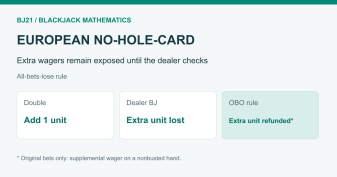
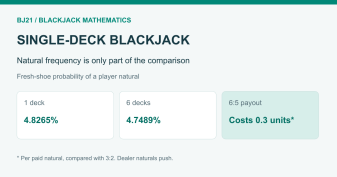
For two other rule comparisons, see our calculations for single-deck natural payouts and the 6:5 penalty and European no-hole-card wager exposure.
Sources and calculation notes
- Michael Shackleford, blackjack rule variations: full-game reference and baseline rules.
- BJ21 glossary: H17 and S17 terminology.
Outcome distributions and standing-hand EVs are original exact recursions for the stated infinite-deck model, rounded only for display. They are not finite-shoe simulations.


Please log in or register to leave a comment