




European No-Hole-Card Blackjack: The Mathematics of Exposed Double Bets

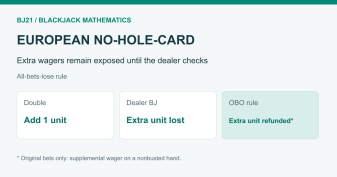
The critical question in no-hole-card blackjack is what happens to the extra money when the dealer eventually reveals blackjack. Does the player lose only the original wager, or also the money added by doubling and splitting?
The dealing sequence alone does not answer that. A dealer can take a second card late while the rules protect supplemental wagers. Conversely, a no-peek game can expose those wagers even when a hole card was dealt at the start. Strategy follows the settlement contract.
Separate three arrangements
| Arrangement | When dealer blackjack is established | Supplemental wager exposure |
|---|---|---|
| Peek game | Before player doubles or splits, after the relevant check | No later exposure to dealer blackjack after a successful check |
| All-bets-lost no-hole-card / no-peek | After player decisions | Added double and split stakes can be lost |
| Original-bets-only refund rule | After player decisions | Qualifying supplemental stakes are returned |
“Original bets only,” or OBO, is used here to mean that the supplemental stake on the non-busted doubled hand in our example is refunded if the dealer has blackjack. Actual rule sheets may handle busted or split hands differently. Do not infer those details from an acronym.
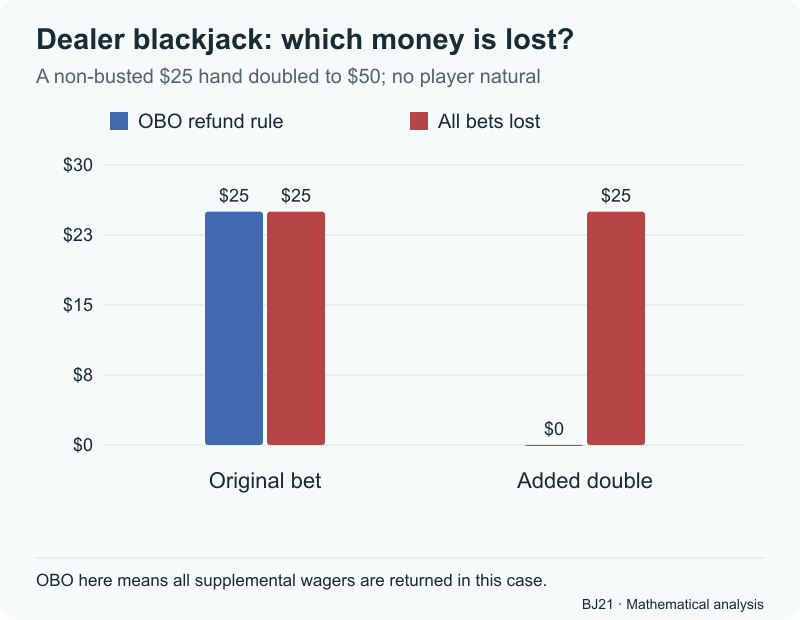
The missing term in a doubling calculation
Let B be the initial wager. Express all EVs in units of B. Let q be the probability of dealer blackjack before it has been ruled out. Let d be the advantage of doubling over hitting, conditional on the dealer not having blackjack.
d = EV(double | no dealer blackjack) − EV(hit | no dealer blackjack)
Consider a hard 11 double, which cannot bust with its single draw, against a dealer ten. In the dealer-blackjack branch, an all-bets-lost double loses two units while hitting loses one initial unit. The difference is −1. In the no-blackjack branch, the difference is d.
EV(double) − EV(hit) = (1 − q)d − q
The −q term is the price of putting one extra wager at risk. A calculation that compares only outcomes after ruling out dealer blackjack omits that price.
Derive the break-even conditional gain
Doubling beats hitting in this model only when (1 − q)d − q > 0. Rearranging gives:
d > q / (1 − q)
Use an infinite-deck approximation to isolate the effect. With a dealer ten up, an ace completes blackjack, so q = 1/13. The required conditional gain is (1/13)/(12/13) = 1/12, or 0.083333 wager units.
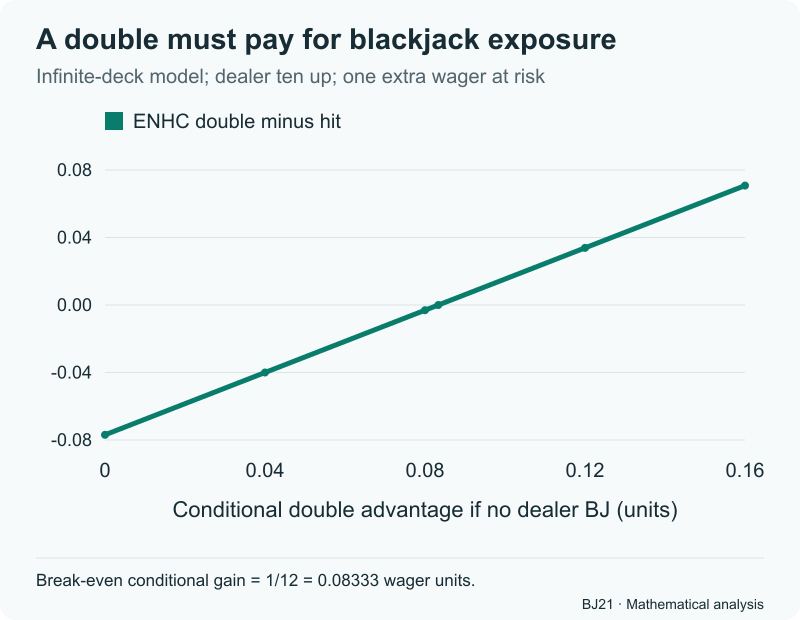
Suppose the conditional advantage of doubling is 0.06 units. This is an invented example, not a computed value for a particular two-card composition. After a successful dealer peek, the double would be better by 0.06. Before an all-bets-lost resolution, the comparison becomes (12/13) × 0.06 − 1/13 = −0.021538 units. On a $100 initial wager, doubling is now worse by about $2.15 in expectation.
If the conditional gain were 0.12, the comparison would instead be +0.033846 units. The rule penalizes the extra wager; it does not logically prohibit every double against a possible blackjack.
| Hypothetical conditional gain d | All-bets-lost double minus hit; dealer ten |
|---|---|
| 0.04 | −0.040000 units |
| 0.08 | −0.003077 units |
| 1/12 ≈ 0.083333 | 0.000000 units |
| 0.12 | +0.033846 units |
| 0.16 | +0.070769 units |
An ace upcard changes the size of the exposure
In the same infinite-deck model, a dealer ace completes blackjack with any ten-valued card, so q = 4/13. The threshold for one additional exposed wager becomes (4/13)/(9/13) = 4/9, or 0.444444 units. The mathematical penalty is substantially larger.
These probabilities assume independent rank probabilities on each draw. Finite shoes, known cards and the player’s draw sequence require a composition-aware calculation. Substituting a convenient off-the-top probability into every real hand is not exact.
Refunds remove a term; they do not make all rules identical
If the added double stake is refunded on dealer blackjack, both actions in our example lose the original one unit in that branch. Their difference there is zero, leaving (1 − q)d. Thus the extra dealer-blackjack penalty disappears from this particular comparison.
Splitting is more complicated. There may be multiple supplemental stakes, resplits, doubles after splitting and hands that already busted. The blackjack-branch difference must use the actual refund rules and the actual wager exposure. Replacing all of that with the single-double formula can be wrong.
Surrender also needs an explicit timing rule. A surrender that remains valid against dealer blackjack is not equivalent to one available only after blackjack has been excluded. Likewise, a successful peek changes the information used for the subsequent decision.
Use a strategy chart with the same settlement rules
Shackleford’s European strategy reference specifies a six-deck S17 game, doubles restricted to hard 9–11, doubling after splitting, and loss of all wagers to dealer blackjack. It reports a 0.62% house edge for that package. The figure does not describe every game dealt in Europe or every game without a hole card.
For an actual table, record the exact refund treatment first, then the remaining rules. A count-based departure needs indices generated for the same arrangement. A double that is favorable after a peek may be unfavorable before the dealer’s blackjack risk has been settled.
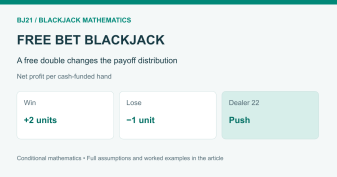
Compare this exposure with the cash-hand and token-hand payoffs in Free Bet Blackjack: that analysis focuses on who funds the added wager and what each outcome pays.
Sources and calculation notes
- Michael Shackleford, European blackjack strategy: specified rules and reference edge.
- Ask the Wizard, no hole card and no peek: why supplemental wager treatment is decisive.
Exposure diagrams, threshold equations and worked hypothetical gains are original. The infinite-deck model isolates one decision mechanism and is not a complete finite-shoe strategy solver.


Please log in or register to leave a comment