




Blackjack Deviations Chart and Index Plays

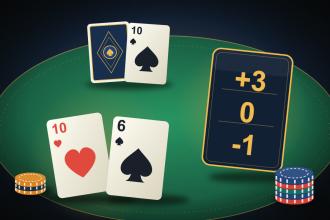
A blackjack deviations chart lists the plays where a card counter breaks basic strategy because the count says a different play is better. The most valuable are taking insurance at a true count of +3, standing on 16 against a 10 at 0 or higher, and standing on 15 against a 10 at +4. This page gives the full Hi-Lo index list for a multi-deck, dealer-stands-on-soft-17 game.
What a blackjack deviation is
Basic strategy is the best play for every hand when you know nothing about the cards left in the shoe. A card counter does know something. When the shoe is rich in tens and aces, standing, doubling and splitting get stronger. When it is rich in small cards, hitting gets stronger.
A deviation is a switch from the basic strategy play once the count reaches a set number. That number is the index. Each play has its own index, and the chart is simply the list of them.
The indices below are for the Hi-Lo count, the most widely used card counting system. They do not transfer to other systems. Don Schlesinger ranked the most valuable Hi-Lo index plays in Blackjack Attack and called the top 18 the Illustrious 18. His four most valuable late-surrender plays are known as the Fab 4.
How to read the deviations chart
Every line gives a hand, the dealer's up card, the play, and an index. The index is a true count. The rule is the same for all of them:
- Zero or positive index (stand, double, split, surrender, insurance): make the deviation when the true count is at or above the index. Below it, play basic strategy.
- The hit plays on 12 and 13: basic strategy stands. Make the deviation, hit, when the true count falls below the index.
Example: 16 against a 10 has an index of 0. Basic strategy hits it. At a true count of 0 or higher you stand. At -1 or lower you hit.
Example: 12 against a 5 has an index of -2. Basic strategy stands. You keep standing at -2 and above, and you hit only when the true count is -3 or lower.
The indices assume Hi-Lo, six decks, dealer stands on soft 17 and double after split allowed. Deck count and rules shift some numbers by a point or two, so treat them as the standard multi-deck set.
The Illustrious 18
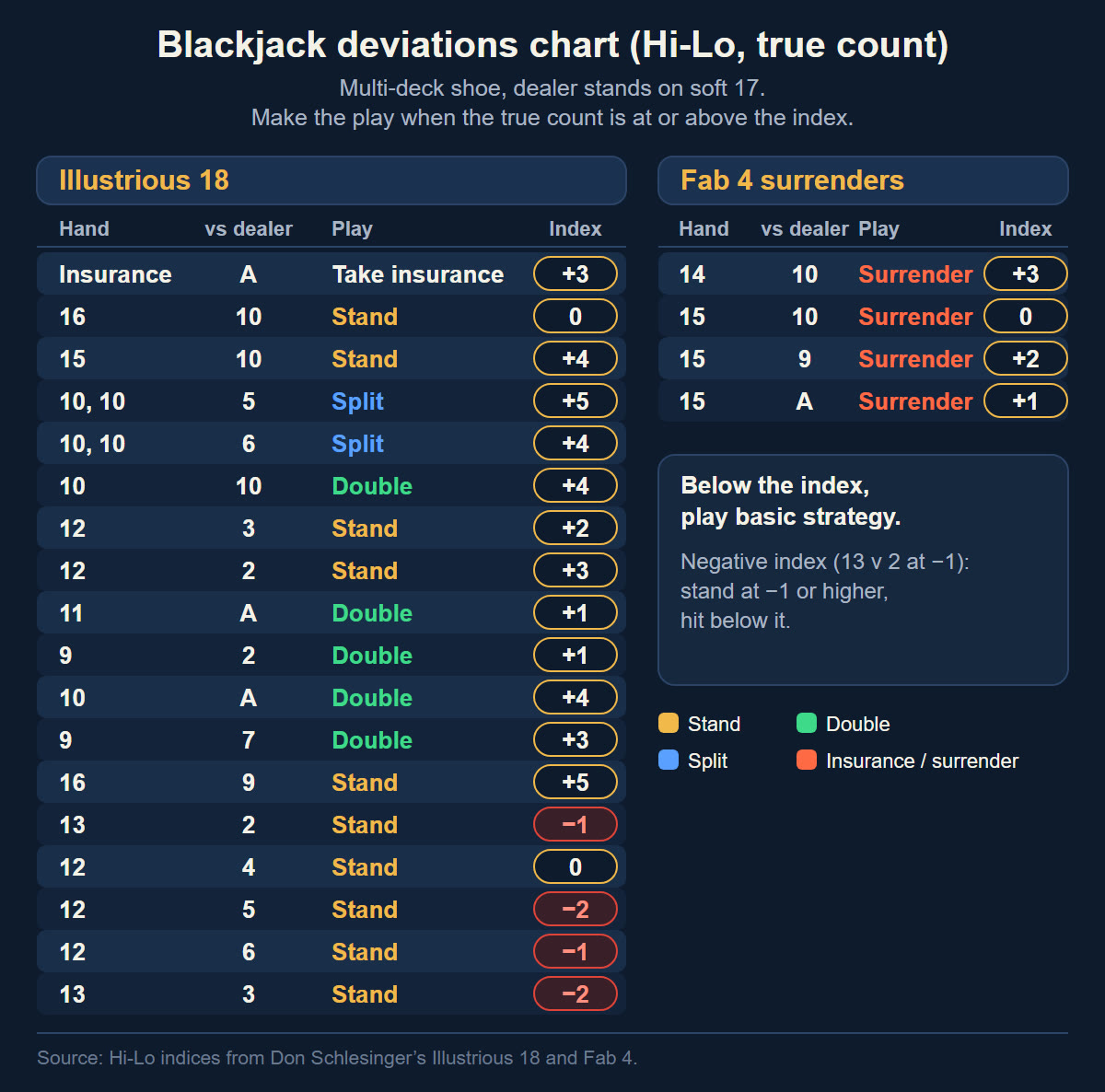
These 18 plays are listed in order of value, with insurance first. Learn them in this order and you capture most of the gain from index play.
| Hand | Dealer | Play | Index |
|---|---|---|---|
| Insurance | A | Take insurance | +3 |
| 16 | 10 | Stand (otherwise hit) | 0 |
| 15 | 10 | Stand (otherwise hit) | +4 |
| 10,10 | 5 | Split (otherwise stand) | +5 |
| 10,10 | 6 | Split (otherwise stand) | +4 |
| 10 | 10 | Double (otherwise hit) | +4 |
| 12 | 3 | Stand (otherwise hit) | +2 |
| 12 | 2 | Stand (otherwise hit) | +3 |
| 11 | A | Double (otherwise hit) | +1 |
| 9 | 2 | Double (otherwise hit) | +1 |
| 10 | A | Double (otherwise hit) | +4 |
| 9 | 7 | Double (otherwise hit) | +3 |
| 16 | 9 | Stand (otherwise hit) | +5 |
| 13 | 2 | Hit below the index (otherwise stand) | -1 |
| 12 | 4 | Hit below the index (otherwise stand) | 0 |
| 12 | 5 | Hit below the index (otherwise stand) | -2 |
| 12 | 6 | Hit below the index (otherwise stand) | -1 |
| 13 | 3 | Hit below the index (otherwise stand) | -2 |
Splitting tens is the most debated play on the list, because you give up a strong 20. It only makes sense at high counts, which is why the indices are +4 and +5. See splitting tens in blackjack for the full argument.
The Fab 4 surrenders
If your game offers late surrender, four more plays are worth learning. You surrender when the true count is at or above the index. Below it, don't surrender: hit.
| Hand | Dealer | Play | Index |
|---|---|---|---|
| 14 | 10 | Surrender | +3 |
| 15 | 10 | Surrender | 0 |
| 15 | 9 | Surrender | +2 |
| 15 | A | Surrender | +1 |
Surrender takes priority over the stand and hit plays above. With 15 against a 10, you surrender at 0 or higher and hit below 0. The 15 v 10 stand at +4 only applies when surrender is not offered.
These are late surrender indices, for games where the dealer checks for blackjack before you can surrender.
Running count to true count
The indices are true counts, not running counts. The running count is the plain total of Hi-Lo values: +1 for 2 to 6, 0 for 7 to 9, and -1 for tens and aces. The true count adjusts that total for how many decks are left to deal.
True count = running count / decks remaining.
Worked example. You are playing a six-deck shoe. About two and a half decks have been dealt, so 3.5 decks remain. The running count is +7.
- True count = 7 / 3.5 = +2.
- You hold 12 against a 3. The index is +2, so you stand.
- You hold 12 against a 2. The index is +3, so you hit, because +2 is below it.
- The dealer shows an ace. Insurance needs +3, so you decline.
The same running count of +7 with only 1.5 decks left would be a true count of nearly +5. That is why the divisor matters: a given running count is worth much more late in the shoe.
Estimate decks remaining from the discard tray, and round to the nearest half deck. Whatever rounding method you choose, use it every time.
Which deviations matter most
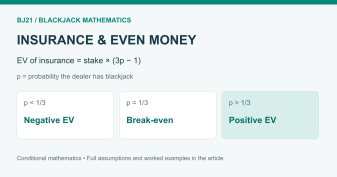
Insurance is the biggest single play. The bet pays 2 to 1 and wins when the hole card is a ten, and at a true count of +3 or higher the shoe holds enough tens to make it profitable. It also comes up every time the dealer shows an ace, so you get many chances to use it.
After insurance, 16 against a 10 and 15 against a 10 are the next most valuable. They happen often and carry a lot of money. The Fab 4 surrenders and the 12 against 2 and 3 are also common.
Some indices occur rarely. 16 against 9 at +5 and 10,10 against 5 at +5 need a high count and a specific hand, so they add little. If you are learning, start at the top of the list and add plays as the early ones become automatic. Knowing the first six well is better than half-knowing all 22.
Deviations add to the edge you get from counting. They do not replace a good bet spread. Basic strategy, a count and a bet ramp come first, and deviations come after.
S17 vs H17 deviations
The chart on this page is for a dealer who stands on soft 17. If the dealer hits soft 17, most of the Illustrious 18 stays the same, with two changes that published sources agree on.
- 11 against an ace: in H17 games, basic strategy already doubles, so the +1 deviation disappears.
- Surrenders: the Fab 4 shift more under H17 than the other plays do. With late surrender, H17 basic strategy already surrenders 15, 16 and 17 against an ace, so those indices move or drop out.
We have not given replacement numbers here, because published H17 values vary with deck count and other rules. If your game hits soft 17, use a chart built for those exact rules rather than adjusting this one by hand.
How to practise deviations
- Learn basic strategy cold first. A free blackjack trainer drills it until your answers are instant.
- Add the count. Deal cards one at a time and keep the running count until you can go through a deck in about 30 seconds and finish on zero.
- Convert to a true count. Practise with a part-dealt shoe, estimate the decks left, then divide.
- Add plays in groups. Start with insurance and 16 and 15 against 10. Then the 12s, then the doubles and the rest.
- Drill index cards. Write the hand and dealer card on one side and the index on the other. Test yourself until the answer is automatic.
Practise at casino speed, with distractions. A play you only know in a quiet room is not yet a play you can use at the table.
Blackjack deviations FAQ
What is the difference between basic strategy and deviations?
Basic strategy is the fixed best play for each hand. A deviation changes that play once the count reaches a set index.
What is the Illustrious 18?
It is Don Schlesinger's ranked list of the 18 most valuable Hi-Lo index plays, published in Blackjack Attack. It covers insurance, standing and hitting, doubling and splitting.
Do I need to know every deviation to win?
No. Insurance and the 16 and 15 against 10 give you the largest share of the gain. Add the rest over time.
Are these deviations for any count system?
No. These numbers are for Hi-Lo. Other systems have their own indices.
Does the number of decks change the indices?
Yes, a little. The numbers here are the standard multi-deck set. Single-deck and double-deck games have their own index sets, and a few plays move by a point or more.
Can I use deviations when I am not counting?
No. A deviation only makes sense with a true count to compare it against. Without a count, play basic strategy.


Please log in or register to leave a comment