





Free Blackjack Trainer Guide - What to Practice and How
A good blackjack trainer does one job: it makes the right decision automatic before you sit at a real table. Whether you want a free blackjack trainer to fix your basic strategy or you are learning to count cards from scratch, the useful question is not "which app?" but "what should it make me practise, and in what order?" This guide covers both, plus a routine you can follow.
What a trainer should drill, in order
Skills build on each other, so practise them in the order you would learn them.
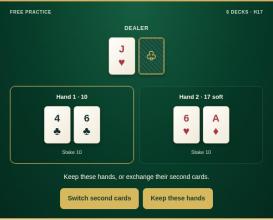
1. Basic strategy. Everything else rests on it. A trainer should deal random hands, grade every decision and let you set the rules, because the correct play changes with the table: dealer hits or stands on soft 17 (H17/S17), double after split (DAS), surrender, and the number of decks. If you want the charts on paper first, see the basic strategy decision chart, the basic strategy matrix and the specific basic strategy matrix for any blackjack game.
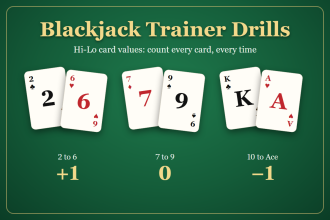
2. Running count speed. Under Hi-Lo, cards 2 to 6 count +1, 7 to 9 count 0, and 10, J, Q, K and A count -1. Drill this with a single deck first, then a full shoe. The Hi-Lo point values page is the reference.
3. True count conversion. The running count means little on its own, because the same number matters more when few decks remain. True count is the running count divided by the decks remaining. A running count of +6 with three decks left is a true count of +2.
4. Deck estimation. This is the step most apps skip. You judge how many decks are left from the discard tray, then divide. A trainer that shows a tray and lets you check your estimate is worth more than one that simply hands you the number.
5. Index plays. Counters deviate from basic strategy at certain true counts. The Illustrious 18 is a well-known set of such plays. You do not need them all at once; bj21's piece on how many index numbers to learn helps you decide.
6. Bet spreading. Counting only pays if your bets follow the count. Practise raising and lowering bets by true count, and see the optimum bet chart for the idea.
Features worth having
- Feedback on every mistake, ideally with the reason, not just a red mark.
- Configurable rules and deck numbers, so you drill the game you will actually face.
- A stats or error log, so you can see which hands you keep missing.
- Speed drills, because real tables run at the dealer's pace, not yours.
- Mobile use, because short phone sessions are easier to keep up than long ones at a desk.
- No real-money gambling. A practice tool has no reason to take your money.
Free trainers worth trying
Blackjackinfo.com offers several free tools that cover the drills above. We checked these pages while writing this guide:
- Blackjack Strategy Trainer: you play hands and each decision is checked against basic strategy for the rules you set. The page describes coach settings that warn you, correct you afterwards, or give no feedback, plus a Stats view for finding your weak spots.
- Card Counting Trainer: a Hi-Lo trainer using a six-deck shoe by default, with optional checks of your running and true count before the deal, and a discard tray you can use to estimate decks left.
- Blackjack Strategy Drills: one decision per hand, grouped by hand type (stiff hands, soft hands, pairs, doubling, surrender), with drills for Hi-Lo index plays including the Illustrious 18.
A practical practice routine
- Week 1, basic strategy. Short daily sessions using your table's rules until errors are rare. Review your error log, then drill only the hands you miss.
- Week 2, the count. Learn the Hi-Lo values, then count down a single deck. A full deck should end on 0 because Hi-Lo is balanced, which gives you a built-in check. Many counters aim to get through a deck in well under a minute, then faster. Treat any time as a rough guide. Accuracy comes first.
- Week 3, add distractions. Count while playing out hands with basic strategy, then add noise or conversation.
- Week 4, conversion and estimation. Practise judging decks left from a tray and converting to a true count.
- After that, indexes and bets. Add a few index plays at a time, then bet spreading by true count.
A short daily session beats a long weekly one. If the count or the strategy slips, go back a step.
Train on paper as well as on screen
Screens are quick, but paper forces recall. bj21's free lessons suit it: try the basic strategy decision exercise, the basic strategy decision test and the basic strategy reconstruction chart. For counting, work through Card Counting 101 and More Card Counting 101, which includes Hi-Lo practice with a marked deck.
One honest note: a trainer builds skill, but it cannot remove the house edge. Only accurate, disciplined play can reduce it.
Discuss it with other members
Green Chip members have been discussing a free blackjack trainer with tips, stat tracking and deck estimation that also works on mobile. If you are a member, you can join the conversation in the Green Chip members' discussion.
FAQ
Is there a free blackjack trainer?
Yes. Blackjackinfo.com has a free strategy trainer and a free card counting trainer. Look for any tool that grades each decision and lets you set the rules.
What is the best way to practice blackjack?
Start with basic strategy for your table's rules, then add counting skills in order: running count, true count, deck estimation, index plays, bet sizing. Short daily sessions and an error log work best.
Can a blackjack trainer teach card counting?
It can build the skills: count speed, true count conversion and deck estimation. Pair it with a written course such as Card Counting 101 so you understand why the numbers work.
What is the best blackjack training app?
We do not rank apps. Judge any trainer by the features above: feedback on every mistake, configurable rules, stats, speed drills and no real-money play.


Please log in or register to leave a comment