




Card Counting Spanish 21 - How It Differs From Blackjack
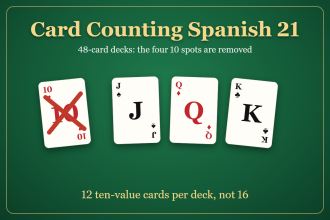
Yes, you can count cards in Spanish 21, and some advantage players do. But it is not blackjack with a different name. The deck is different, the rules are different, and a count you learned for blackjack will not work unchanged. This guide covers what changes, why, and where to study it properly.
What makes Spanish 21 different
No tens. Spanish 21 is played with 48-card decks: a standard deck with the four 10 spot cards removed. The jacks, queens and kings stay, so there are still ten-valued cards, but 12 per deck instead of 16. Games are dealt from six or eight decks.
Liberal player rules. Removing tens favours the dealer, so the game gives the player rules to compensate. The usual ones are a player 21 that always wins, a player blackjack that beats a dealer blackjack, doubling after splitting, re-splitting aces, doubling on any number of cards, and late surrender. A distinctive one is double down rescue: after doubling you may surrender and give up only your original bet. Some casinos also allow redoubling. Others restrict drawing to split aces, which costs the player.
Bonus payouts. A five-card 21 pays 3 to 2, a six-card 21 pays 2 to 1, and a 21 of seven or more cards pays 3 to 1. A 6-7-8 or 7-7-7 pays 3 to 2 in mixed suits, 2 to 1 in one suit and 3 to 1 in spades. None of these are paid on a doubled hand. Some games add a large "super bonus" for a suited 7-7-7 against a dealer 7, which is extremely rare.
Spanish 21 is a licensed game, and unlicensed equivalents are usually called Spanish blackjack. Rules differ from casino to casino, and the next section shows which ones move the edge most.
Spanish 21 vs blackjack: the house edge
Katarina Walker's simulations of basic strategy give these house edges:
| Rules | 6 decks | 8 decks |
|---|---|---|
| Dealer stands on soft 17 (S17) | 0.37% | 0.38% |
| Dealer hits soft 17 (H17) | 0.78% | 0.80% |
| H17 with redoubling | 0.42% | 0.45% |
Wizard of Odds lists 0.40% for S17, 0.42% for H17 with redoubling and 0.76% for H17 without it, without stating the deck count. The two sources agree closely. Individual rules move the edge: losing the right to draw to split aces adds roughly 0.28%, and a natural after a split paying 3 to 2 takes off 0.16%.
So the dealer's soft 17 rule and redoubling matter far more than the headline "liberal rules". Check them first.
Why basic strategy changes
A blackjack chart will cost you money here. With the tens thinned out, many hands are weaker than in blackjack, and decisions are reshaped by the bonuses, double down rescue and the rule that your 21 always wins. Wizard of Odds, for example, notes that hitting a 17 against an ace with three or more cards is correct in some spots. You need separate Spanish 21 strategy for H17 and S17 games, and more tables for redouble games. For where Spanish 21 sits among the other games, see bj21's overview of blackjack variants and advantage play.
Can you count cards in Spanish 21?
Yes, with adjustments. Here is what follows directly from the deck:
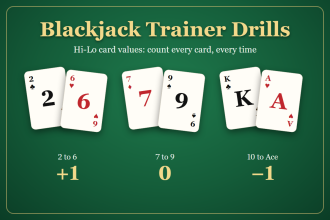
- Hi-Lo is no longer balanced. In blackjack, Hi-Lo gives +1 to the 2 through 6 and -1 to tens and aces, and a full deck sums to zero. Remove the four 10 spots and a 48-card deck has 20 cards at +1 and 16 at -1 (12 ten-valued cards and 4 aces). That sums to +4 per deck, so counters start the running count at a negative number, in effect -4 per deck, or use an adjusted count. The Hi-Lo point values page has the standard tags.
- The ten-rich signal is weaker. In blackjack, a rich supply of tens and aces is what you bet on. Here tens are a smaller share of the deck (12 of 48 against 16 of 52), so the count is working with fewer of the cards that matter most.
- Play decisions matter. The game's strategy already differs a lot from blackjack, so index plays are tied to Spanish 21 strategy, not blackjack indexes.
- Aces are a bigger share. Four of 48 cards against four of 52, and they drive blackjacks and bonus hands.
Why do many counters skip it? You need to learn a second strategy and a second set of counting numbers, and the rules change from casino to casino. Why do some play it? The base house edge is low and the rules reward skilled play. For the general question of whether a game is worth the effort, read what pro blackjack players look for.
If you are new to counting, learn standard blackjack first. Card Counting 101 is the place to start.
Further reading: Katarina Walker's book
The Pro's Guide to Spanish 21 and Australian Pontoon by Katarina Walker has a foreword by Don Schlesinger. The listing describes 208 pages covering optimal play, counting methods adapted from blackjack (including the Hi-Lo system and indices), betting and money management, house edge, EOR and standard deviation, camouflage and finding the best games. It is a print-on-demand paperback sold through Lulu. Walker's simulation figures are the ones in the table above.
Discuss it with other members
Green Chip members have discussed card counting Spanish 21 versus card counting blackjack. If you are a member, you can join the conversation in the Green Chip members' discussion.
FAQ
Can you count cards in Spanish 21?
Yes. Hi-Lo can be adapted to the 48-card deck, but the count is unbalanced without the tens, so you start from a negative number and use Spanish 21 indexes, not blackjack ones.
What are the Spanish 21 rules?
Six or eight 48-card decks with the four 10 spots removed, a player 21 that always wins, player blackjack beating dealer blackjack, double after split, re-splitting aces, and bonuses for five-card or longer 21s and certain 6-7-8 and 7-7-7 hands. Most casinos allow late surrender and double down rescue.
What is the difference between Spanish 21 and blackjack?
The deck has no 10 spots, the player gets more liberal rules and bonus payouts, and the strategy is different. With basic strategy the house edge is about 0.37% (S17, six decks) or 0.78% (H17, six decks, no redoubling).
Is there a book on Spanish 21?
Yes: The Pro's Guide to Spanish 21 and Australian Pontoon by Katarina Walker, covering strategy, counting, indices and betting.


Please log in or register to leave a comment