



.png)



Card counter sues Biometrica, Biloxi IP, security guard, local police in patron abuse incident

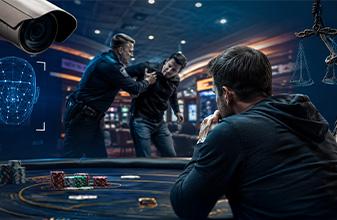
It is unfortunate that modern blackjack literature mostly ignores the fact that violence and other patron abuse still occurs at the hands of casino employees. Though it certainly does not occur as often as perhaps twenty years ago, mostly because a generation of casino employees has retired or otherwise moved on, there are still plenty of thugs employed in casinos.
The allegations in this case present an interesting study in what still goes on, even in substantial organizations which should be better managed with better hiring and supervision practices, and sometimes in alliance with local authorities in venues with several large casinos, such as Biloxi. Whether the fact that those casinos are often the largest employers and taxpayers in those regions has any effect on the actions taken by the local authorities is left for the reader to contemplate.
This is a false arrest and malicious prosecution case, combined with claims of intentional infliction of emotional distress, negligent infliction of emotional distress, general common law negligence, gross negligence, and civil rights violations.
Defendant Zachary Longino, a security officer of defendant IP Casino Resort Spa, provided false information to the City of Biloxi Police Department and caused plaintiff to be arrested for creating a public disturbance at a business. Then IP followed through with the malicious prosecution of plaintiff in Biloxi Municipal Court. What Longino and IP did not reveal to the Biloxi Police is that Longino is the one who created the disturbance by threatening Plaintiff with violence to intimidate and harass him, and he verbally abused him. IP surveillance identified plaintiff as a blackjack card counter and “Advantage Player” upon information believed to have been harvested by defendant L’Auberge Casino Resort and given to defendant Biometrica Systems, Inc., a facial recognition software firm that databases Advantage Players for its casino clientele. Plaintiff never even played a single hand of blackjack at IP. Longino met him at the table as he was buying in with the intent of evicting and harassing him. L’Auberge and Biometrica are named as co–defendants in the resulting lawsuit because they routinely database Advantage Players knowing that casinos often mistreat them, as was done here. Furthermore, L’Auberge is a Louisiana casino, and it is against Louisiana state law to exclude Advantage Players, precisely because their exclusion often results in violent mistreatment by overzealous casino security personnel.
The discovery process may reveal the plaintiff is one of a much larger group who suffered the same type of harm from these defendants. If so, plaintiff Edward Vanhoy, a Louisiana resident, reserves the right to ask the Court to certify him as the lead plaintiff of a class action lawsuit so that his attorneys may better manage these potential plaintiffs’ identical claims. If this case develops into a class action lawsuit, plaintiff will move for leave to file an amended Complaint that “relates back” to the filing of the original complaint.
Defendant Boyd Gaming Corporation is a North American corporation that owns and operates 29 casino properties in 10 states including Louisiana and Mississippi. Boyd is the parent corporation of defendant Boyd Biloxi, LLC, dba IP Casino Resort Spa. Boyd is named as a separate defendant for discovery purposes, and because its policies, employee hiring and training, and tendency of abusing Advantage Players caused plaintiff’s injuries.
PENN Entertainment, Inc. is a North American casino corporation that owns and operates over 40 properties across 20 states including Louisiana and Mississippi. PENN is the parent corporation of defendant PNK (Lake Charles), LLC, dba as L’Auberge Casino Resort. Lake Charles (“L’Auberge”). PENN is named as a separate defendant for discovery purposes, and because its policies, employee hiring and training, and tendency of abusing Advantage Players caused plaintiff’s injuries.
Biometrica Systems, Inc., dba as Biometrica, is a security software company incorporated and located in Nevada. They are known for providing facial recognition services. They are doing business in Mississippi; the IP casino is a client of theirs.
The City of Biloxi Police Department is the law enforcement body for the City of Biloxi, Mississippi. The are being sued under 42 U.S.C. §1983 for conspiring with one or more of the other co–defendants to violate the plaintiff's civil rights under color of state law.
Overview of casino brutality towards advantage players
Plaintiff is a blackjack card counter and Advantage Player, which is perfectly legal in every U.S. jurisdiction.
Casino gambling brought in close to $110 billion of revenue for U.S. operators in 2023, when the IP incident that gave rise to this lawsuit occurred. This revenue is generated by the “house edge” in each of the casino games. Card counters have about a 1% advantage on average. See, Anthony Cabot & Robert Hannum, Advantage Play and Commercial Casinos, 74 Miss. L.J. 681 (2004–2005). Card counters flip the house edge in their favor. In other words, the longer they play the more money they grind away from the casinos, just like the casino grinds the money away from the non–skilled patrons. Even though the casinos are making money hand over fist, they don’t like to lose––at all. Casinos and card counters play a “cat and mouse game” with one another, and sometimes this game gets rough.
When card counters are proficient enough at their craft to become a serious
monetary threat, casinos either take countermeasures against them, or they exclude them. Countermeasures include shuffling every hand, placing card counters on a flat–bet restriction, or “backing them off” blackjack. Like Nevada, Mississippi casinos are free at common and statutory law to evict Advantage Players from their properties. Most times these evictions are done politely. But when casinos still follow the old style ways of brutality and intimidation, these evictions are not so polite.
Take judicial notice of a documentary film called Inside the Edge: A Professional Blackjack Adventure (2019). In the documentary, former Advantage Player (now casino consultant) Max Rubin recalls: “I’ve been (dragged) in the back (room). I’ve been punched. Friends of mine have been burned with cigarettes. Friends of mine have had their jaws broken. Friends of mine have been threatened to be murdered.”
Rubin isn’t exaggerating. Several years ago, in Reno, a casino patron was killed by an overzealous security guard.
Factual allegations
Vanhoy entered IP casino property intending to play blackjack. He had never played there Before. Vanhoy is able to describe the following events with great particularity because of discovery material provided to his attorney when he was facing the false disturbing the peace charges in Biloxi Municipal Court. A digital surveillance video was provided to Vanhoy’s attorney that has audio commentary of IP surveillance on it.
IP surveillance noted that plaintiff was listed on the database service “Biometrica,” thus confirming that IP subscribes to and is a client of Biometrica’s facial recognition service. It is revealed in the video that plaintiff flagged up on IP surveillance radar the moment he drove into their parking garage. According to their website (https://biometrica.com), Biometrica provides its facial recognition services to law enforcement as well as casinos. Based on the IP surveillance video, it appears that Biometrica may be abusing its law enforcement access to invade the privacy of the Advantage Players they database and obtain and share their license plate numbers with their casino clients. Biometrica wrongfully treats Advantage Players like criminals.
There are two L’Auberge casinos in plaintiff’s home state of Louisiana: one in Baton Rouge, and the other in Lake Charles. The IP surveillance video doesn’t say which “L’Auberge” (PENN Entertainment, Inc. owns both properties), but it was probably the Lake Charles L’Auberge who reported to Biometrica that plaintiff is an Advantage Player. Plaintiff has never had any incidents at the Baton Rouge L’Auberge, but he was thrown out of the Lake Charles L’Auberge for counting cards several times. Plaintiff kept returning to L’Auberge Lake Charles casino to count cards because it was his right to do so. In the state of Louisiana, casinos cannot legally exclude Advantage Players. Louisiana Revised Statute §27:27.2(A)(3)(b) states: “A person may not be excluded from a gaming establishment operated by a licensee or the casino operator for reasons based solely on the skill level of the person.” The intent of this Louisiana law was to prevent skilled players from being mistreated. Notably, under Louisiana Revised Statute §27:27.2(A)(3)(b), while casinos can exclude individuals for unlawful or disruptive conduct, they cannot do so merely because someone is an Advantage Player. This distinction may be relevant to what happened to the plaintiff. Longino may have been looking for a pretextual reason to exclude plaintiff permanently from every casino.
Once players develop a reputation and an arrest record for creating public disturbances they can legally be barred everywhere, even under Louisiana law. IP surveillance said they were dispatching security to deal with Vanhoy, and they were going to “back him off.” A “back off” in the card counting culture is when a pit boss or surveillance officer politely tells the patron something to the effect of, “You are welcome to play any other game in the house, but no more blackjack.” This is not what happened.
We cannot hear it in the surveillance video because it has no audio from the casino floor, but according to the plaintiff the following words were spoken by Longino. He tapped plaintiff on the shoulder whereupon he turned to see Longino and a team of IP security guards looming behind him. Longino said (word–for–word what was reported), “You’ve got some f---ing nerve coming into my casino. You better get out of here before I kick your f---ing a--.” And Longino said to the dealer, “Push his f---ing money back; his money is no f---ing good here.” Plaintiff is then seen on the video flipping off Longino as Plaintiff tries to exit the casino. Longino taunts a visibly flustered plaintiff as he tries to find the nearest exit (calling him a “faggot,” and other inflammatory and defamatory ad hominem insults) and Longino and plaintiff exchange harsh words.
It is irrational to the extreme that a seasoned card counter would react as plaintiff did in the video to a polite back off. Seasoned card counters don’t respond to polite back offs that way; they quickly and quietly make an exit in order to preserve the other casino games for future play (there are other opportunities for Advantage Play besides blackjack) and to avoid beat downs.
Longino’s remarks “triggered” plaintiff and emotionally distressed him. Plaintiff is a war veteran with seven campaigns of duty in Iraq and Afghanistan, and he has been diagnosed with PTSD as have many of our veterans. He showed remarkable restraint not to physically engage with Longino and to exit the property without incident.
The IP surveillance video does not support a charge of publicly disturbing a business. The other patrons at the table are generally minding their own business, oblivious to the drama between Longino and plaintiff; except for the moment on the video where patrons were visibly shocked by Longino’s threats towards plaintiff and glared at Longino in disbelief IP surveillance video followed plaintiff to his car, a red BMW, and continued to follow him until he drove off and away from IP property.
Plaintiff tried to drive away and got as far as Bayview Avenue. At that point, Biloxi Police stopped and arrested the plaintiff for disorderly conduct based on the complaint of Longino.
Body cam footage from the arresting officers shows that, although plaintiff was visibly upset, he acted peacefully and did not resist arrest.
Plaintiff was held in handcuffs by the Biloxi Police while Longino made his way to plaintiff’s stopped car. When Longino arrived, the Biloxi Police allowed him to make a “citizen’s arrest” of plaintiff. Longino read plaintiff his Miranda rights and told him he was being arrested for creating a public disturbance.
In the Investigative Narrative by the arresting Officer Hudson #72, Hudson recounts that Zachary Longino told him Vanhoy created a public disturbance of a business when he asked him to leave, but Longino completely left out the details where he was the one who created the disturbance by threatening plaintiff with violence and cursing him with highly inflammatory language. Longino also signed a false affidavit and submitted it to the Biloxi Police Department.
Vanhoy and counsel appeared at Biloxi Municipal Court ready for trial on multiple occasions, but ultimately the charges were dropped because IP’s witnesses failed to come forward to testify. The trial judge summarily dismissed the complaint.
There is ample evidence to suggest that, not only did the Biloxi Police Department arrest plaintiff at Longino’s behest without properly investigating the probable cause for the arrest, the BPD may have contributed to the circumstances that caused Longino to threaten and verbally abuse Vanhoy to begin with.
Who alerted IP that Vanhoy, a known “Louisiana Advantage Player” was coming their way? Was it the BPD? Was the BPD working in conjunction with Biometrica? Was the BPD acting as an arm of the IP surveillance department? These are all highly plausible scenarios based on the evidence. Who else patrols the streets of Biloxi and would have had access to this information? At the very least the BPD owed plaintiff a duty of care to investigate Longino’s allegations carefully and independently, especially since casinos have a long and documented history of abusing Advantage Players
Potential class action lawsuit reiterated
Plaintiff reiterates that it is highly plausible discovery in this case will reveal numerous persons were similarly injured by these defendants (and perhaps by other Louisiana and Gulf Coast casinos, too). If discovery reveals that there is a large class of plaintiffs with similar tort and civil rights injuries, plaintiff will move for leave to file an amended complaint that “relates back” to the filing of the original complaint per FRCP 15(c) and ask that this case be certified as a class action lawsuit.
Source:
“EDWARD VANHOY v. BOYD GAMING CORPORATION; ZACHARY LONGINO, in his personal capacity and in his official capacity as a security officer of IP Casino, et al.” , MARVIN VINING, Esq., marvinvining@mac.com, United States District Court Civil No.1:26cv192 HSO–BWR, Document 4, July 17, 2026.
Published with permission of the author, edited for length and clarity for this format.


Please log in or register to leave a comment