




Polymarket and Kalshi now taking bets on U.S. measles
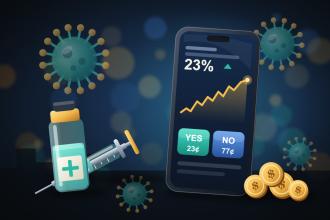
In the Brooklyn borough of New York City, the sign was affixed to a construction fence adjacent to an elementary school. At first glance, it looked like any other public health message on the significance of getting vaccinated. "Vaccines" was declared in large capital letters against a background of blue stars.
However, "Will any state end vaccine markets?" was written in tiny letters at the bottom of the sign. The logo for Polymarket, an online prediction market where users may sign up to bet on the results of almost any event—including, currently, public health and the measles outbreaks—was included with it.
Kalshi, another online prediction market that started providing health-related predictions over the summer, has joined Polymarket. Users can bet on whether the U.S. Centers for Disease Control and Prevention (CDC) will alter its vaccination recommendations or when the US Food and Drug Administration (FDA) will approve a skin cancer vaccine.
According to Lia Nower, a professor and head of the Center for Gambling Studies at Rutgers University, prediction markets are essentially uncontrolled even if they are functionally identical to regulated gambling, mostly akin to sports betting. “(Prediction markets) right now (are) like the wild, wild west. There’s no federal regulatory body that’s really prescribing any limits on any of this, or just minimum guidelines for states to follow – so anything’s possible.”
According to Nower, prediction markets operate under federal commodities laws, are overseen by the U.S. Commodity Futures Trading Commission, and are not subject to state regulation as gambling operations because they present themselves as financial derivatives rather than traditional bets in a regulatory loophole. A number of states have sued the businesses, claiming that they operate as gambling websites.
Nower went on to comment that there don't seem to be any rules prohibiting advocates, officials, and legislators from placing wagers on abolishing vaccine mandates at the state level, for example, and then introducing new laws or policies to do so. There are wagers on when certain health agency officials will depart, which may be impacted by choices about resignation or firing.
Critics claim that predictions may potentially have an impact on drug testing and regulation. Drug corporations could alter the scheduling of trials, and trial participants could deliberately alter their behavior to influence results.
Forecasts regarding FDA rulings and trial outcomes could create a payoff for anyone with nonpublic information, including legislative staff, trial investigators, and agency reviewers. The risk isn't necessarily that a reviewer takes a bribe – it's that the market now rewards leaks. To counter that reality, prediction markets might develop their own protections.
Concerns about consumer safety and the possibility of insider trading are driving states like New Jersey to impose market restrictions, according to Nower. According to her, people with inside information or control over an outcome could potentially profit from what they call “event contracts,” which is another term for the forecasts.
However, she noted that there were few public health proposals on the market and advised against interpreting them as an indication of public opinion. Prices that small can be moved by a single trader and shouldn't be read as public opinion. On the childhood vaccination schedule, a few hundred-dollar contract is not a reliable forecast of anything.
The Brooklyn Polymarket sign was vandalized within a week. The words about making a prediction and the Polymarket logo at the bottom were torn out. The sign now just says, "Vaccines."
Source:
“Health is wealth? Polymarket and Kalshi now host bets on measles and other US health crises” , Melody Schreiber, theguardian.com, November 14, 2026.


Please log in or register to leave a comment