





.png)


Banks vs. cryptocurrency in Washington D.C.

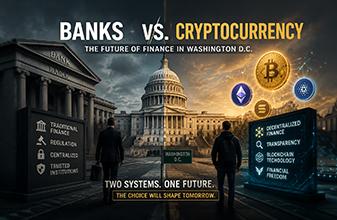
In the Republican-controlled United States Senate, powerful banking interests, accustomed to winning when Republicans have power in Washington D.C., are about to suffer a startling public loss.
A historic cryptocurrency measure is expected to advance this month when senators move forward with a bipartisan approach to resolve a dispute between banks and cryptocurrency firms that banking industry lobbyists detest.
Crypto is of strong interest to online casino operators because of the intense use of it in online gaming. Even though its use is less in the United States than elsewhere throughout the world, most experts are nearly certain that will change going forward.
The battle's apparent outcome demonstrates how the banking sector's long-established lobbying power is being supplanted by the crypto business, which is still a relatively new special interest in Washington. While banks have profited from more accommodating GOP-appointed regulators during the second Trump administration, they have spent the majority of the last two years battling emerging cryptocurrency firms that have spent hundreds of millions of dollars on lobbying and politics, using brutal tactics to secure significant policy victories.
The question of whether specific cryptocurrency companies should be permitted to provide rewards programs that provide yearly percentage return to clients who own stablecoins—a kind of cryptocurrency intended to keep a $1 value—is at the heart of the most recent dispute between the two industries.
The problem is portrayed by both sides as an existential conflict. Banks claim that the incentive schemes enable cryptocurrency firms to imitate interest-bearing bank accounts and may lead consumers to switch from traditional banks to cryptocurrency platforms. Crypto firms have retaliated, claiming that banks are attempting to "ban" their rivals.
The largest goal of the cryptocurrency industry on Capitol Hill, a comprehensive plan to create a generally industry-friendly set of laws that will push crypto closer to mainstream banking, has stalled due to the issue.
A Senate Banking Committee markup of the cryptocurrency bill in January was postponed by Thom Tillis (R-N.C.) and Angela Alsobrooks (D-Md.) due to their worries about bank deposit flight. However, banks are already criticizing the lawmakers' compromise, claiming it does not go far enough in combating cryptocurrency rewards schemes.
Rewards on a payment stablecoin balance that are operationally or economically equal to paying interest or yield on an interest-bearing bank account would be prohibited by the Tillis-Alsobrooks agreement. In private, bankers claim that even while Tillis and Alsobrooks share their objectives, the wording nevertheless allows cryptocurrency companies to offer rewards that resemble interest paid on a conventional bank account.
Many lawmakers consider local bankers and state industry trade associations to be important constituents, and if they engage in more aggressive lobbying on the matter, they may be able to influence more members. However, the White House and Congressional Republicans have made the underlying crypto law a high priority, and blocking it would be a serious political risk.
In response, banks have increased their own political expenditures. Late last year, the Financial Services Forum, which represents the eight biggest U.S. banks, established a nonprofit that is anticipated to have about $100 million.
The Tillis-Alsobrooks transaction falls short, according to a joint statement by a number of leading bank trade bodies. Although they claim to have made major concessions to the banks, cryptocurrency companies are generally willing to accept the Tillis-Alsobrooks agreement.
The last year has proven more sobering despite the banking industry's widespread excitement for Trump's election in 2024, which is demonstrated by banks' stock values rising high in anticipation of tax cuts, deregulation, and the possibility of more consolidation. The financial services sector and banks have achieved certain regulatory successes, such as looser lending requirements and less stringent oversight, but the banks continue to lose the battle over cryptocurrencies.
Since late 2025, a number of cryptocurrency companies have been awarded trust charters or narrow banking charters by government regulators, which has enabled them to enter the mainstream financial sector. The idea of (restricted) access to the Fed's desired payment system for cryptocurrency and digital asset companies, has also been proposed by the Fed. A digital asset startup was granted trial access to the system in March.
Additionally, the president has occasionally become enraged with the banking sector. Trump went so far as to sue JPMorgan Chase for allegedly debanking him and his family businesses early in the year. The banks and Congress rejected his call for credit card firms to cap their interest rates. Bank supporters want to close what they see as unresolved gaps in the cryptocurrency laws, but they have already lost their two strongest partners in the battle in Tillis and Alsobrooks.
Online casino operators worldwide will continue to keenly watch the ongoing proceedings.
Source:
“Wall Street went to war with crypto. It’s losing.” , Jasper Goodman and Aiden Reiter, Politico.com, May 6, 2026.


Please log in or register to leave a comment